
 Menú
Menú There are four Va et Vient lifts in the world. All four are at Portillo.
That’s not a marketing line. It’s a consequence of geography, avalanche science, and one French engineer’s refusal to accept that certain terrain was simply unreachable.
The problem that required an invention
In the 1960s, Portillo’s mountain operations team faced a straightforward engineering problem with no straightforward solution. The resort’s most dramatic terrain — the steep couloirs that would become Roca Jack, Condor, Las Vizcachas, and El Cara Cara — was sitting idle because there was no way to get skiers up there. Building conventional chairlift towers through those chutes was not just difficult. It was functionally impossible. Avalanches regularly swept through the area, making permanent tower installation futile.
The solution came from Poma — the French lift manufacturer that had already built some of the most innovative mountain infrastructure in the Alps. Poma designed a unique suspended surface lift that allows skiers to access the desired terrain without placing any structures in avalanche paths. The design is almost absurdly simple in principle: the lift is anchored only at the top of the mountain with a return pulley, with no towers anywhere along the line. The cable floats. The terrain below can do whatever it wants.
How it actually works
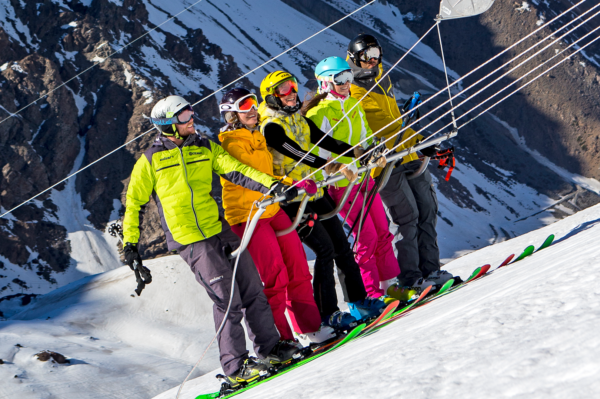
Watching a Va et Vient in motion for the first time, most skiers aren’t sure what they’re looking at. Four or five skiers are pulled up the mountain at once, each sitting on a disc attached to a bar, connected to the tow cable by a flexible rope. The ride up is very fast and feels a bit like water skiing.
Two tow bars with platter seats are attached to the haul rope, and an operator starts and stops the lift at designated points. The whole assembly moves at a pace that surprises first-timers — this is not a gentle beginner drag lift. By the time you reach the top, you’re at altitude, on steep terrain, with your heart rate already up before you’ve made a single turn.
The dismount is where most first-timers get into trouble, and where having a plan matters. The proper way to disembark is for skiers to leave the lift one at a time, starting with the skier on the end that doesn’t have the safety rope. If this isn’t done properly, it usually results in at least one — if not every — skier falling. The last person lets the bar with the discs go back up, so that nothing drags on the ground during the descent of the carrier.
The protocol sounds complicated. After one or two rides, it becomes second nature.
What’s waiting at the top
The Va et Vient exists to deliver skiers to terrain that has no equivalent in South America and very little equivalent anywhere. Roca Jack is the signature run — a steep, sustained pitch with the kind of exposure that makes intermediate skiers stop at the top and quietly reconsider their life choices, and makes advanced skiers start planning their second lap before they’ve finished the first.
The natural snow conditions range from powder to packed powder to corn snow in spring, providing a rewarding challenge for the more advanced skier with an adventurous spirit. On a powder day — and Portillo has more of those than almost anywhere in the hemisphere — Roca Jack is the run that people fly thousands of miles for.
The views from the top are their own justification. The entire Aconcagua massif opens up to the east. On clear days, you can see into Argentina. The resort sits at the center of the Andes, with only a maximum of 450 hotel guests on the mountain at a time. At the top of the Va et Vient, that translates to something increasingly rare in skiing: genuine solitude above 3,000 meters, on terrain that earned its reputation.
First-timer’s guide
A few things worth knowing before you ride:
Talk to your group before you load. Agree on the dismount order before the lift starts moving. The operator will wait while you sort this out — they’ve seen every possible variation of the first-timer experience.
Keep your poles forward. The acceleration at the start is faster than it looks from below. Leaning slightly forward and keeping your poles in front helps you stay balanced through the initial pull.
Don’t fight the rope. The flexible connection between the bar and the cable absorbs terrain variations. Let it do its job. Skiers who try to muscle through it have a harder time than those who relax and trust the mechanism.
Pick your moment to release. The operator controls when skiers dismount, but you control how cleanly you do it. A clean release, a quick step to the side, and you’re done. The whole sequence takes about three seconds.
The lift that defines the mountain
Portillo has chairlifts. It has conventional surface lifts. It has all the infrastructure a modern resort requires. But none of those define the place the way the Va et Vient does.
It’s a piece of engineering built specifically for this mountain, on terrain that no other solution could reach, producing an experience that — by definition — cannot be replicated anywhere else. Skiers who’ve ridden it talk about it the way mountaineers talk about a particular summit: not just as a means to an end, but as something worth doing for its own sake.
There are four Va et Vients in the world. The trip to Portillo is, among other things, the trip to ride them.
Everything you need to plan your season in Portillo


