
 Menú
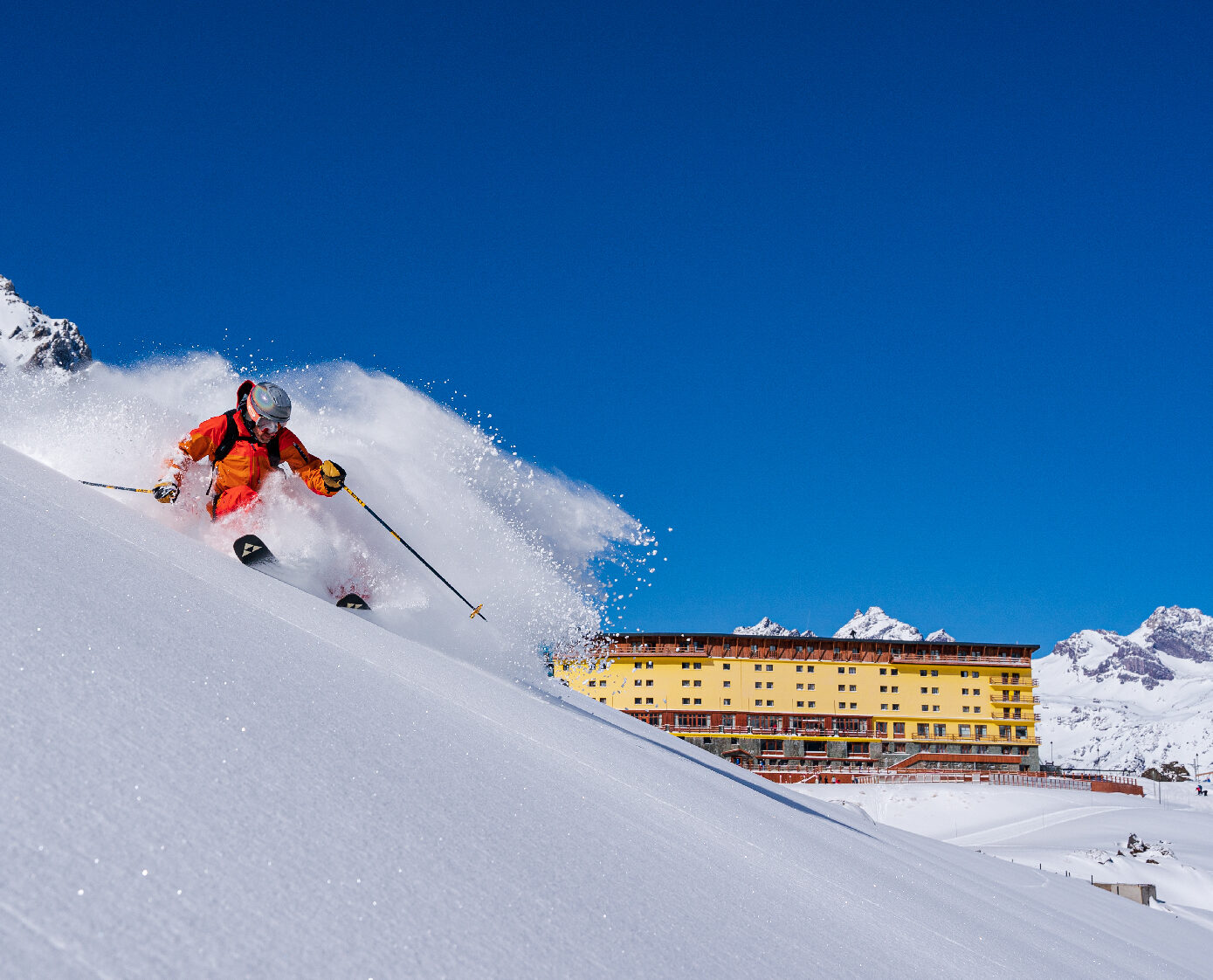
Menú There’s a reason skiers who’ve skied Portillo talk about the snow the way sommeliers talk about a rare vintage. It’s not nostalgia. It’s physics.
The mountain that catches the storm
Portillo sits at 2,880 meters in a natural amphitheater carved into the Andes, right where the Aconcagua River valley funnels Pacific storm systems directly into the resort. When a front moves in from the coast, it has nowhere to go but up — and as it rises, it drops moisture at altitude, in temperatures cold enough to produce snow with an unusually low water content.
That low density is everything. Colorado powder averages around 8% water content. Utah’s famous “Greatest Snow on Earth” hovers between 6% and 8%. Portillo regularly measures below 5%. Skiers call it “champagne powder.” Meteorologists call it “low-density snow.” Either way, it’s the kind that explodes around your shoulders on every turn and disappears into the air like smoke.
A desert that occasionally becomes a paradise
The Andes are, paradoxically, one of the driest mountain ranges on the planet. The Atacama Desert — the driest place on Earth — sits just to the north. This aridity is not a flaw in Portillo’s story. It’s the secret.
Because storms here are rare, the snowpack doesn’t compact and refreeze the way it does in the Alps or in the American Rockies, where moisture accumulates gradually over weeks. At Portillo, a single storm can drop 80 centimeters overnight. Then the sun returns, the cold holds, and that snow stays light and untouched — sometimes for days.
The resort receives an average of 430 centimeters of snowfall per season, concentrated in intense events separated by long stretches of bluebird weather. The result is a mountain that alternates between epic powder days and perfect groomed corduroy, with very little in between.
The Laguna del Inca effect
Below the resort, Laguna del Inca — the frozen lake that has no visible outlet and has never been fully explained by scientists — creates a microclimate that skiers feel but rarely think to question. The lake’s surface, frozen for most of the season, reflects solar radiation upward rather than absorbing it, keeping valley temperatures lower than they would otherwise be. It’s a natural refrigerator for the snowpack.
Indigenous Inca legend holds that the lake contains the body of an Inca princess, preserved forever beneath the ice. Science offers a more technical explanation involving subterranean drainage. Neither version fully accounts for the color — a surreal turquoise that has no business existing at this altitude, in this cold.
Why it skis the way it skis
The combination of low-density snow, high altitude, and low humidity produces a surface with remarkably low friction. This is why intermediate skiers at Portillo often describe skiing here as suddenly feeling better than they are — the mountain gives more than it takes. And it’s why advanced skiers who come chasing the Va et Vient lift and the steep lines of Roca Jack find conditions that rival, and often exceed, anything they’ve found in Japan or the American West.
The snow at Portillo isn’t a lucky accident. It’s the product of a specific geography, a particular atmospheric pattern, and a century of skiers learning to read a mountain that rewards patience and punishes assumptions.
Some things are worth flying to the southern hemisphere for.
Everything you need to plan your season in Portillo


